|
Our goals and our plans to be financially free and wealthy have nothing to do with “enough.” I went beyond enough a long time ago. Why do I need to make so much money? What do people work for? Robert Kiyosaki wants us to work toward things – assets – which will add value to our portfolio or balance sheet or safety deposit box. Rather than liabilities with continuing costs. Most folks labor to buy more “things” without realizing they are liabilities rather than assets – like houses, vehicles, toys, etc. Kiyosaki might say, “Work so that one day you will have abundance and not deficits.” We certainly can agree that it is better to collect assets than liabilities. That making money work for us is preferable to just working for money to turn over to the bank or to the government. Still, Kiyosaki has made MONEY and RICHES the focal points of his life. He has spent much of his life bowing to them rather than any other “god.” This writer finds it interesting that Robert recognizes at least two different kinds of money: the usual kind which the government prints and we use to transact business and another kind which he calls “God’s money.” Gold and silver are God’s money in Robert’s mind because he believes it will always have value. But … God’s money? Doesn’t every earthly thing come from God and return to God? “Do
not store up for yourselves treasures on earth,
where moths and vermin destroy, and where thieves break in and steal.” Gospel of Matthew So, we believe that material wealth in any guise can become problematic. It can in particular be detrimental to one’s health through a variety of mechanisms. This writer looks at several parts of Rich Dad, Poor Dad from wider, deeper and also historical standpoints seeking the bigger picture. As a matter of simple fact, almost all who read this little book already have abundance. We are collectively and individually at this time – in the American West in the 21st Century – far richer than the majority of kings who have lived over the centuries – and even some monarchs in the hinterlands of the present day. We have amenities, comforts, and luxuries far beyond the imaginings of Caesar and Cleopatra, Napoleon and Josephine, Henry the VIII and his several wives. In modern times, there is a vignette which may be relevant that circulates and which rural folks like to repeat. It goes that young folks are eager to hurry off to the city to earn large sums of money. So that they can eventually buy property and retire in the countryside. But, maybe such folks are merely “circling the wagons” since they are already in the Promised Land – in a worldly sense. How much is enough? Mr. Kiyosaki admits in Fake that, “I went beyond enough a long time ago.” He goes on to say that money can be a game or an addiction. And we know where addictions can lead. This brings to mind a quick conversation the writer had with his younger brother prior to the US Presidential Election of 2012 between Barack Obama and Mitt Romney. My brother had to remark that, “Well, Romney isn’t for the poor.” The response was, “Do you know any poor people?” Brother took a breath and said, “Well, you can be poor if you can’t take a vacation.” A novel and somewhat revealing answer. America has poor people, but like most everything that poverty is quite relative to time, place and person as suggested above. Relevant to the basic premise of Rich Dad, Poor Dad, a huge portion of people on the planet today are wealthy in comparison to … You can take your pick from the billions of humans who have populated the planet as far back as we can see or imagine to fill in that blank. From another angle, we can ponder upon – The Richest Person on the Face of the
Earth
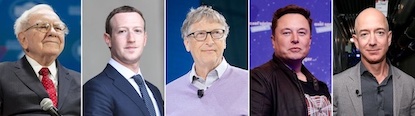 There is recurring debate and wonderment about who is the richest person in the world. Forbes magazine has been keeping track of the wealthiest on the planet and posting its Billionaires List since 1987. Names like Elon Musk, Warren Buffett, Jeff Bezos, Mark Zuckerberg, and Bill Gates along with lesser notables appear on that list and in the media with respect to membership in the Kings of Green Club. But, we think there may be a different way to look at who is the World’s Wealthiest and determine who is the Richest Person on Earth. If you agree with our premise, you may come to a surprising conclusion. There are always fresh perspectives waiting for our eyes to consider. Let’s start from a Wide Angle by focusing on incarnation in the 21st century AD. What a gift it is to live in this era of human history. Being born in this time period, we have the potential to live several lifetimes in one. Then, we can accomplish much more in that one lifespan. Short as it seems to be. Many societies living until recent generations could claim average lifespan of only 40 years. Ours is nearing close to twice that. So from that standpoint alone, most of us moderns get the equivalent of two lifetimes. Nevertheless, there are people on the prairie who have not traveled outside of the county which surrounds their abodes. The same thing might be said about some people who live in big cities. While the opportunities are available, many still only experience one quite common but useful life: day to day and year to year as millions have over the generations and centuries. Maybe that is simply their karma. But, maybe there are other possibilities. The Hutterites in Montana still live simple lives as communal farmers. As opposed to the Amish, they do use motorized vehicles. But not computers – except for farm operations. Although cellphones are making inroads into their unusual-to-modern-eyes existences. I suspect few of the Amish and Hutterite people ever get to travel outside their native states. Then, there is the other hand. A friend in her 80th year boasted of having made 50 different moves in her lifetime. That surely is not a record, but would be something nigh impossible in other time periods. Still, we don’t have to be itinerants or vagabonds to experience the expanses of this vast learning ground called Planet Earth. Modern transportation and communications allow for contact with far stretches of the world and its billions of human and trillions of animal and plant inhabitants for our study and experience. Then, the wonders of books and libraries expanded people’s horizons when Gutenberg developed his printing press in the 15th century. But now, computers and digital libraries allow for geometrically greater possibilities for study and learning. Billions of books are close at hand to most all of us in one form or another. All sorts of opportunities surround us – and lie within us – if we only take the time to look for them in the midst of the vast number of modern distractions. The people we meet, the events in our lives, the places we travel, the books we read can all bring us to recover the wonders of our past existences, to right the wrongs we have done, and help build a better world. Even to bring the kingdom of heaven to light in our very midst. It seems as if it is all here right now within our reach, closer than our right hands. If we are about our work, we can be assured that when we return next time there will be much more goodness to go around. Fewer wars, less need for armies. More opportunities to give and share and create. Again living in the USA in the 21st Century, all of us experience many kinds of wealth. Think of the simple amenities we take for granted each day which have been unknown to royalty a few generations past and still are in some parts of the world: •
potable water out of the tap – then hot and cold and
iced on demand
• vast choices of foods – fresh, frozen, dried, canned • sheltered comfort – a roof over one’s head • warm or cool air at the press of a switch • instant communication to most every part of the world • ready transportation to take us here there and most anywhere • entertainments by talents of all kind, again on demand And, we have yet to directly mention personal relationships. Think how many people you and I can contact in our lives. How many friends, partners, groups we can join. How many intimates we can attract – or vice versa. Then, consider for a moment – marriages. One lone marriage was the norm – except for kings and caliphs – for millennia. Now in the West, multiple marriages are probably more common than single ones. That does not even broach other possibilities for romantic relationships in our time. We have to mention in this vein a one-time neighbor who was reported to have been married 13 times. She may have broken her own record by now. Judy even surpassed the main character in Somerset Maugham’s humorous short story, The Round Dozen. “But, what about the money, the financial part of riches,” you might ask, “that set Musk, Buffett, Bezos, and Gates apart from the rest?” We have two responses: 1) In the West, most all of us have more money pass through our hands in a few days than folks in past centuries did in months or years. Even today while we live with thousands of dollars, people in third world countries today manage with pennies and pesos. We don’t have to be Warren Buffett to enjoy money and consider ourselves rich. 2) Then we say, “The truest riches are family and friends, happiness and love, nature and beauty. They can not be measured or counted or collected.” But, these are the intangibles which we can take with us here there and everywhere – even when we part the physical plane. Mother Teresa spoke decades ago of the material deprivation in the East and the spiritual deprivation in the West. All we need really do is to look around at the wonders of nature, the gifts of life, and the abundance of creation to sense how rich we are even in difficult times and circumstances.  Then, we are reminded of the words of baseball great, Lou Gehrig. Mr. Gehrig played seventeen years at first base for the New York Yankees. He was known as one of baseball’s most durable players and finest hitters. Yet, the Iron Horse was diagnosed at age 36 with a disease which took his life in two years. Nonetheless, Lou recognized how fortunate he was and had been as he gave his farewell address to fans at Yankee Stadium in 1939: “For the past two weeks you have been reading about the bad break [the illness] I got. Yet today I consider myself the luckiest man on the face of the earth.” Join me in shouting, “I consider myself the richest person on the face of the earth.” Read
on at Royal
Disease
|
Introduction - Table of Contents
Online Reading