A Sound Mind in A Sound Body
or
A Sound Body in a Sound Mind
|
Chapter
5
 “The medical profession is only now beginning to concede that … just maybe, the mind is somehow mysteriously linked to the body. Of course, there’s not much money in that thinking.” George Carlin George Carlin would have loved some of the “word games” we have been playing. George, the high-school dropout, somehow developed into a Master of Words. In part because, “I love words. I thank you for hearing my words. I want to tell you something about words that I think is important. Words are my work, they’re my play. They’re my passion. Words are all we have really. We have thoughts, but thoughts are fluid. And, then we assign a word to a thought and we’re stuck with that word for that thought. So be careful with words. The same words that hurt can heal.” Remember that, “His words gave us, then and now, a way to see the world. He has been missed every day by countless folks everywhere looking for a really hard laugh at the darkest possible moments.” Lewis Black George would cheerfully join in the brain-mind debate which is of overarching significance in regard to Dementia. Orthodox medicine and the media, which relies on the former, equate the brain and the mind. Thus, the monopoly that the brain holds upon studies of mental disorders in general and dementia in particular. Brain-based psychology and psychiatry are limited for many reasons. Neuroscience rules the two professions, even though generations of studies have failed to show that the mind is a product of the brain. Some day, we will be able to grasp the wonders of the Universal Mind, the Collective Conscious, and the Personal Conscious which exist beyond the realm of the physical brain and the material world. How far off that day may be, we dare not say. But, science and medicine are beginning to move in that direction. They are already helping to show mind as of much greater import than body and brain. Leading in this direction, let us make note of the case of the physician Rolf Alexander who learned to hear (after he was nine years old) even though he had no inner ear bones. There are surely many other examples of people learning and doing all sorts of things without – what might be commonly considered – necessary equipment. Let’s now consider some of the current information which indicates that the mind is a much greater and more important entity than the brain: • In his book Space, Time and Medicine, Larry Dossey discussed the research of a British neurologist, John Lorber, whose work questioned the premise that “an intact cerebral cortex is even required for normal mentation.” Dr. Lorber utilized computerized brain xrays to study hundreds of patients with hydrocephalus, a condition in which fluid gradually replaces brain tissue. “He discovered that many of his patients had normal or above-normal intellectual function even though most of the skull was filled with fluid. Normally, humans have a cerebral cortex measuring four and one-half CENTIMETERS in thickness, containing 15 to 20 billion neurons. In one patient, however, a college mathematics student who was referred to him because his physician suspected that his head was slightly enlarged, the brain scan revealed a cerebral cortex of only one MILLIMETER in thickness. Functioning, with only a tiny rim of cortical brain tissue of 1/45 normal thickness, this student proved to be gifted on standard IQ testing (he had an IQ of 126) and was normal not only intellectually but socially.” Dr. Dossey also cited exceptional cases of individuals who had entire hemispheres removed from their cerebral cortex as treatment for intractable epileptic seizures. These procedures are commonly followed by permanent paralysis, speech disturbances, and memory or reasoning deficits. Yet, there are numbers of patients who do not react in typical ways. They recover fully and sometimes become truly gifted people.  Gabby
Giffords – And a Mystery
To bring Dossey’s
observations nearer in time and place, we can recall
the tragic shooting in Tucson, AZ, in January 2011.
Six were killed, and 15 injured including US
Representative Gabrielle Giffords who was maimed
with a blast at close range to her head while she
was meeting with constituents outside a supermarket.
The bullet entered near her left eye and passed
through the left side of her brain before exiting at
the back of her skull.Both she and her husband, now US Senator Mark Kelly, had been hard-charging, service-oriented Americans then – and still are. But, their lives were already changing prior to that incident – and dramatically disrupted thereafter. Even twelve years ago, Gabby had noted a sense of the nastiness which seethed around her political world, sensing it was “almost like people are going to get violent.” And, they did. And, one killer acted so on that fateful day. Gabby Giffords’s recovery and rehabilitation were considered extraordinary. Kelly told that 95 percent of people experiencing such wounds die immediately. He recognized that “the brain is still a mystery,” while Gabrielle slowly regained most of her usual abilities. Initially, she suffered paralysis as well as aphasia, like many stroke victims. Always fun-loving, quick-witted, and smart, Gabby understands everything going on around her. But after a dozen years, words still don't come readily to her. It takes a lot of work. Beyond routine physical and speech therapy, Giffords has returned to playing the French horn which she first started at age 13. In recent years, she has been taking lessons again – five days a week. Music and singing have been definite helps for Gabby on her long path to recovery. She has used music to help with words – understanding and speaking them. Music is still inside her. Where might that be? But reading sheet music is hard. Relearning to hold her French horn and getting the fingerings right were challenging. Music therapy is thought to work by “inducing brain plasticity.” But unsurprisingly, “Just how it works remains unclear.” Still, Gabby Giffords keeps playing.  Mora Leeb – A Glass Half Full Girl In recent days, the story of Mora Leeb has circulated around the internet. To early outward appearances, all had been well for mother and child until … For the first three months Mora made her milestones: She nursed; she rolled over; she smiled — and then it came to a standstill. Seizures began when she was 4 months old, barely noticeable at first — but by February 2008 they were clustering 20 per minute, hundreds in a day. Brain scans were interpreted to suggest major damage to Mora’s left hemisphere resulting in epileptic seizures. No explanation was given as to how the infant developed normally for her first months with the brain damage believed to be due to “a massive stroke she had experienced in utero.” Doctors tried to control the seizures with medication, but the drugs had little effect. In June 2008, when Mora was 9 months old, neurosurgeons operated and removed her damaged brain tissue – the left half of her brain. It was suggested to be like a reset. But, progress didn’t come easily or quickly for Mora. She began walking at 23 months, didn’t speak in sentences until she was 6, and she was 8 when she learned to tie her own shoes. With much therapy and time, Mora progressed well without half her brain until … Today, for this 16-year-old from South Orange, NJ, each ordinary action Mora takes — walking, talking, reading a recipe, dealing cards, joking — has involved a painstaking learning process. She grew up with only half a brain. Still five years ago, Mora had a setback. Her seizures returned which suggested to medics the need for more surgery. In August 2018, neurosurgeons went back and removed the remaining tissue in hopes that the seizures would stop. Mora managed to recover quickly and was even dancing at a family member’s wedding by December. Mora has continued to cope with medical complications — she still takes anti-epileptic medication, she receives Botox injections in her right hand, arm and leg twice a year to keep her muscles loose and she lives with Crohn’s disease as well. Nearly three years after her second surgery, in 2021, Mora stood in front of her synagogue congregation, and hundreds of others tuning in via Zoom, to give her Bat Mizvah speech. “Personally, I can be described as a ‘glass half full’ girl,” she told the crowd. “There are challenges in my life. Things can be difficult. As a family we know that well, but we try to keep moving forward and hope for good times ahead.” Mora remains committed to taking on challenges, including learning to ride a bike. “I am interested in learning most everything,” she says. In many ways, Mora is a typical teen, but her communication skills are still very slow which means it can be difficult for her to make close friends.” When she’s not taking tennis lessons (she started learning in 2017) or reading a favorite book (a dictionary of 700 idioms is top of the list), Mora spends time helping researchers understand how the brain can adapt to trauma. ~~~~~~~
• Surprising data has arisen from studies of the brains of famous and talented individuals. Scientists have long theorized that “Great Minds” must have larger than normal brain size. This idea has been shown to be quite lacking. Consider the case of Anatole France (1844-1924), the great French novelist and Nobel prize winner (1921). He is said to have been a man of true genius and vast mental powers. Yet, autopsy showed France's body to possess a very small brain. The average adult cranial capacity is fourteen hundred cubic centimeters. But the skull of Anatole France, had a capacity of a mere thousand. From a different angle, we can consider animal brains in comparison to human ones. The elephant brain is larger than the human brain in several ways, including weight, neuron count, and the size of the cerebellum. an elephant brain weighs around 4500 to 5000 grams, which is about 3–4 times heavier than the human brain, which weighs about 1300 to 1400 grams. An elephant brain has about 257 billion neurons, which is about three times more than the human brain which 86 billion neurons. The brain of a whale is even larger than the brain of a human. The brain of a sperm whale can weigh up to 9000 grams. The brain of a killer whale can weigh up to 6800 grams. Killer whales, according to long held medical thought, should be geniuses. What do you think? • Noted neurosurgeon, Wilder Penfield wrote in The Mystery of the Mind, “As Aristotle expressed it, the mind is ‘attached to the body.’ The mind vanishes when the highest brain-mechanisms cease to function due to injury or to epileptic interference or anesthetic drug. More than that, the mind vanishes during deep sleep. On this basis, one must assume that although the mind is silent when it no longer has its special connection to the brain, it exists in the silent intervals and takes over control when the higher brain-mechanism does go into action.” Penfield went on to say, “Because it seems to me certain that it will always be quite impossible to explain the mind on the basis of neuronal action within the brain, and because it seems to me that the mind develops and matures independently throughout an individual's life as though it were a continuing element, and because a computer (which the brain is) must be programmed and operated by an agency capable of independent understanding, I am forced to choose the proposition that our being is to be explained on the basis of two fundamental elements. This, to my mind, offers the greatest likelihood of leading us to the final understanding toward which so many stalwart scientists strive.” • Nobel Prize winning surgeon and researcher, Alexis Carrel, concluded in his Man the Unknown that, “Personality is rightly believed to extend outside the physical continuum. Its limits seem to be situated beyond the surface of the skin. The definiteness of the anatomical contours is partly an illusion. Each one of us is certainly far larger and more diffuse than his body.” • Plant physiologist Rupert Sheldrake in A New Science of Life postulated “morphogenetic fields” as invisible organizing fields which act across time and space and are responsible for forms and evolution, behavior and learning. Sheldrake concluded that those fields “can be regarded as analogous to the known fields of physics in that they are capable of ordering physical changes, even though they themselves cannot be observed directly.” • Candace Pert, who performed groundbreaking research on neuro-peptides at the National Institutes for Mental Health, reported in Noetic Sciences Review that “... it is possible now to conceive of mind and consciousness as an emanation of emotional information processing, and as such, mind and consciousness would appear to be independent of brain and body.” She went on to say, “A mind is composed of information, and it has physical substrate that has to do with information flowing around. Perhaps, then, mind is the information among all these bodily parts. Maybe mind is what holds the network together.” Both Pert’s fields of information and Sheldrake’s morphogenetic fields help to explain mind and consciousness, whether of an individual or of a group. Minds of individuals overlap and intertwine to become group, family, national and racial fields of mind. • It seems appropriate to end this section by considering the idea of cellular and tissue life in connection with body-mind issues. Our simple proposition is to look at the memories that we all carry in our own beings. It seems quite impossible – in similar thinking to that as given by Wilder Penfield offered above – to imagine that cells or tissues even of the brain can in and of themselves remember anything. For the simple reason that our body cells, even brain cells, are dying off constantly to be replaced by new ones. It is commonly held that the whole human body is renewed every five to seven years. Cells die and being replaced at a rate of a million every second. Neurons or brain cells have longer life spans. But, they too are all replaced during the life of humans. The obvious implication is that constantly change and renewal within the body and the brain requires some greater force for direction. Memory must therefore be dependent upon more than body or brain tissues. The brain is controlled by the mind which holds the mystery and wonder of memory. “…
it will always be quite impossible to explain the
mind
on the basis of neuronal action within the brain …” Wilder Penfield True Psychology
Medicine ventured into psychology in the 19th century thanks to pioneering physicians. But with some exceptions, they followed patterns set by orthodoxy. Early psychiatrists were trained in neurology (study of the brain and nervous systems) and, to this day, most of their descendants look at mental problems as caused by faulty body, nerve, and/or brain physiology. Thus, the predilection to medicate their patients after surmising “chemical imbalances.” So, even psychiatry is materialistic, body and brain based. The mind certainly deserves more attention in medical school and medical practice. True healers must be adept at psychology for a host of reasons. Here are just a few: • Since the “body is in the mind,” it falls prey to mental-emotional problems in many ways. In fact, the body is clearly the slave of the mind which we often mistreat as well as misunderstand. “The skin of every human being contains a slave.” (Mark Twain) Many minds are unfocused, overly sensitive to surrounding minds and energies, and fogged by worries and fears which cannot but sooner or later influence their dependent bodies. As we all live “in the mind,” our bodies are subject to all kinds of mental stresses. Physicians need to read beyond symptoms to deeper layers in their patients’ beings and lives. • It is commonly suggested that 90 percent of illness is “stress related.” While “stress related” often means “We Don’t Know,” it often hints at emotional overlay, common anxiety, and simple inability to deal with the pressures of daily life. These develop differently depending on the individual. One man’s stress can be another man’s pleasure. Some people thrive on high intensity, frequent change, and deadlines. They may well go ‘stir crazy’ when there is nothing to do. Sitting still can be like a death sentence for them. These folks might be considered Type A, as in recent terminology. Other people behave quite the opposite. People’s minds influence all of us. But generally speaking, the young and the old are at “the low end of the totem pole” in this part of life. They often have limited ways to express and deal with what is going on inside and around them. Both children and elders have relatively more sensitive minds and can’t help but be highly impressed by “bigger” minds around them. Put differently, children and older folks can become decidedly influenced by the auras (mental-emotional fields) of family and associates: to their detriment in not infrequent cases. The frail and the infirm fit this picture as well. For young and old, whatever the age, psychology – study of mind – should and will one day be part of everyone’s education. Then, we will turn the old adage around to say, “A sound body in a sound mind.” Another layer of the human onion will eventually have to be peeled and this should naturally occur through the discipline of psychology. Our present psychological studies barely begin to hint at our deeper potentials and realities. What really sets humans apart is their possession of individual souls. • Some day, psychology – the study of mind – most generally sick minds, will enter into the esoteric work of uncovering the soul. Sad to say, medicine has largely forgotten or given up on the soul. Interestingly, since that is our deepest and continuing nature. But, psychology at least is on target by way of its name to ultimately open medicine and society to the idea of soul. Because its truest meaning is the study of the soul: psyche = soul, logy = study. Scientists have had great difficulty coming to terms with the idea of mind. Again, most still believe it to be synonymous with brain. Humans having souls is even scarier to materially oriented investigators. “This reminds one of the story of the materialistic doctor who said he had done hundreds of post mortem examinations, but had never yet discovered the trace of the soul.” (Arthur Avalon, The Serpent Power) The soul, like mind, is neither accessible to a surgeon’s operation nor a pathologist’s autopsy. But, Eastern yogis and Western teachers have known for centuries about the hidden energies of the Soul which ultimately govern the mind and body. “While, according to Western conceptions, the brain is the exclusive seat of consciousness, yogic experience shows that our brain-consciousness is only one among a number of possible forms of consciousness, and that these, according to their function and nature, can be localized or centered in various organs in the body.” (Anagarika Govinda, Foundations of Tibetan Mysticism) 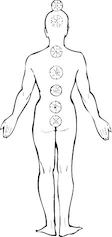 Chakras - Centers of Consciousness • The midway or meeting point for these invisible forces and the outer physical human form is the psycho-neuro-endocrine system. The concept of this system is really quite simple while the practical explication of this subtle network will take long and inventive study. Direct support for this view is now coming from a new slowly evolving medical discipline called psycho-neuro-immunology. Psycho-neuro-immunology springs from the earlier arena of psycho-somatic medicine and will eventually form the scientific foundation of the inclusive field of psycho-neuro-endocrinology. The united function of the nervous and endocrine systems has been hypothesized and demonstrated for many years by a few in the West. “Hence in the largest sense the autonomic nervous system and the various endocrine glands … represent a single neuroendocrine system that has evolved to integrate and coordinate the metabolic activities of the organism.” (Williams Textbook of Endocrinology) Although these systems are now separated by specialization in medical practice, this state assuredly will be modified in the future when the Soul takes its true, but largely forgotten place in life as well as in medicine-healing. Soulless Medicine like Soulless Education is hardly new. Even Plato complained of a similar state of things over two millennia ago. “You ought not to attempt to cure the body without the soul for the part can never be well unless the whole is well.… This is the great error of our day, that physicians separate the soul from the body.” It is high time that Soul – psyche be brought back into common discussion and medical consideration – and not be left for preaching on Sundays. The Divine creates and re-creates, and ultimately dwells within all creatures – most particularly human beings. “The
spirit is the master,
imagination the tool and the body the plastic material.” Paracelsus We take as simple fact, that Soul-Spirit lies behind all of creation, the formation of planet Earth, and the procreation of human beings. That fact is unprovable, but anyone who dares to contemplate the vast wonders of life in and around his/her being is sure to come eventually to that conclusion. • The Mind is somewhat easier to contemplate than the Soul: the Mind being the designer, while the brain functions as the drafting tool – so to speak – in our lives. Mind consciously and unconsciously channels forces to bring about embodiment and expression in the material world. The Mind is the central, mediating factor in evolution, in society and in individual life. For the soul to experience life in material realms, Mind “creates” all manner of organs in order to contact and communicate with those worlds. Our own minds process information and experience through sensory apparatus, means of locomotion, and particular organs which are called into play. Along the way, we develop talents and abilities eventually to share in the world around us. Finally, we can even use the mind to think and ponder the nature of our very own Self. “Everything
consists of mind and its modifications.”
I.K. Taimini • When we understand the Mind as the Builder, then it is logical to recognize the Body [and brain] as the Building. The plasticity of Nature allows for the creation and construction of all manner of “buildings” or forms for beings. Empowered by Spirit-Soul, the universal or individual Mind molds the plastic energy everywhere in the universe to create the forms of living beings. The human body is not simply a collection of cells and tissues, organs and systems. But rather a constantly changing vital structure formed over months – and re-formed over decades – by the subtlest energies which create and sustain a vital “skeleton of forces” rather than merely of bones and flesh. These forces underlie the cellular and organic framework which are apparent to everyday eyes. Although we appear as solid material things, our eyes deceive us constantly as so much of what we perceive is more mirages, rather than the real things. Our minds and senses are not yet evolved enough to register the flowing forces of our deeper nature. To eyes which can see deeply, we are actually energetic beings – fields of force which Einstein described as “dense energy.” Nerves and Minds
A major drawback in “scientific” endeavors is that we search for answers in the physical world, forms, bodies, and brains. They are not to be found there – except with injuries and accidents – which ultimately are also generated at subtler levels. Causes cannot be discovered in the material realm – simply because the physical is not a principle – as noted in Ancient Wisdom. Everything that appears and happens in our midst is due to finer forces beyond common awareness and vision. And, that is just as true in illness as in health. A scenario similar to the following one must have passed before the reader at one point in time or another: A relative, friend, or neighbor has had long-standing discomforts –aches and pains, coming and going, changing from time to time, but not letting go. Neither dire nor specific, but quite disturbing. S/he sees several physicians, because the first doctor “tries” several approaches without luck and then sends the individual on to specialists. They check and test this and that while experimenting with different medications to deal with symptoms. “Let’s try one more thing.” All efforts leave the last medic on the list to say, “We have checked everything. There seems to be nothing organically wrong. The problem must be your nerves or mind. Maybe we should get you to see a neurologist – a psychiatrist if need be.” The “professional” admits to being stumped – after spending much of the patient’s time, energy and money. His/her tools can’t handle the job. So then, the medic is ready to pass the problem on to a “nerve specialist” or a “head doctor.” The large majority of the ills mentioned and illustrated in previous chapters fit into this kind of picture. From those who experience fainting and seizures to Parkinson’s and Alzheimer’s symptoms, sick people struggle to find “professional” help. That professional help most often depends on a diagnosis. That medical labeling and naming process has been developed and refined over generations, but it is too often far removed from bringing clear answers and substantive aid to people in pain, discomfort, and need. Sick people need much subtler, saner, more humane responses to their problems. But, we have created a medical system based on visible, testable things. The system must go beyond testing and medicating to deeper understanding as well as true care and compassion. “There
are no diseases
only sick people.” Samuel Hahnemann It’s All in Your Mind
“A sound mind in a sound body” has been taught to us for millennia since Thales, the ancient Greek. But, moderns like Thales, however well meaning, have this aphorism in reverse order. As noted above, soul and mind come before body. They determine body, govern it, build and rebuild it for years. 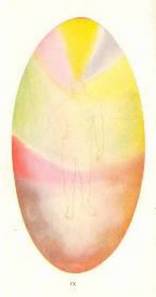 Image of Mental body of Average Man
– from Man Visible and Invisible by CW Leadbeater A field of mind, like our energy body, but broader and subtler, surrounds and interpenetrates every human being. The brain is its chief but not only means of exchange with the physical form as well as the surrounding world. Clairvoyant investigation makes it quite clear that “the physical brain is not the originator of consciousness, but rather its instrument. Acceptance of this concept would have far-reaching effects upon the way we humans look at ourselves, and thus upon the world we live in…. The physical brain, much like a supercomputer, registers, stores and retrieves what the mind discovers and originates.” (The Chakras and Human Energy Fields, Dora Kunz and Shafica Karagulla) The mental vehicle is the source of ideas, also called thought-forms, as well as emotions, which we create and process consciously and unconsciously in the course of our lives. The greatest of these thought-forms are IDEAS which can be borne through us in order to benefit our fellows and humanity as a whole. Emotions are understandably wave-like in form. They wash back and forth in flows or splashes or explosions of color. Thoughts appear more geometrical in lines and surfaces. These structures can be maintained for long periods of time, depending on the power of the emoter or thinker. Pressing ideas and currents of thought as well as potent emotions can be recognized objectively for those with the inner eyes to see. As previously noted, the human mind – mental vehicle – is relatively open to influences from the thoughts of others in its mental neighborhood. Some of our hypersensitive fellows are extremely open to the non-physical emanations of the rest of us. The general Western conception is slowly making room for holistic thinking and living. A few profound thinkers in the modern West have tried to “lift the veil” between mind and body. One of them was Carl Jung. That great psychiatrist spoke and wrote about the collective conscious especially in regard to his teachings on dreams. But, we can take another step to say his Collective Conscious is really another name for the Universal Mind to which we all respond to one degree or another. Fechner called it the World Mind. Humanity interacts with the Collective Mind regularly and frequently – but quite unconsciously most often. In similar manner, we individual humans relate to our own personal minds. It is a fact that humans in toto exist within a vast orb of mind and consciousness, with the latter having its conscious, unconscious and superconscious aspects. All that we experience and recognize is In Our Mind – in one dimension or another. Nothing happens to our outer form nature without registering first and much more deeply in the mind. Interestingly, BF Skinner taught in his book Beyond Freedom and Dignity that there is no freedom or dignity for most humans because we are “conditioned animals.” The reader may wish to ponder on how that conditioning occurs. Paradoxically while trying to present a more holistic picture of the human form and being, we have had to separate that one being into parts – soul, mind and body. Even these can be “subdivided,” but this triune perspective will hopefully be sufficient to help the reader understand Mind as we travel from Dementia to Rementia. After all, it is apparent from traditions and religions far and wide that the Universe is Triune in nature as is its Creator. So, lesser creations including humans are also triune in expression. As mentioned earlier, the human mind is a force field of energy which underlies the body. It not only underlies the body, but it also interpenetrates it. The mind actually symbolizes – out-pictures the inner reality in and through the physical body. The soul and mind are the foundation of the Doctrine of the Subtle Body. That Doctrine has stood for millennia for those interested and with their own minds evolved enough to ponder the notion “that the physical body of man is as it were the exteriorization of an invisible subtle embodiment of the life of the mind …” (GRS Mead) The constitution of humans has been known “to be of the nature of a dynamic system of energy” of which the mind and soul are the most fundamental. Saint Paul was well aware of the subtle body, mind and soul, as he spoke clearly: “If there is a physical body, there is also an immortal body.” (1 Co 15:44) So again, the soul and mind and body are interpenetrating forces of Nature – Nature being the Garment of God. (Goethe) There are layers to our existence, most of them being quite invisible to all but a very few seers. Modern technology has been able to uncover and use hidden forces such as infrared light, ultraviolet rays, radio waves, and other energies of wide array. Future eras will see much subtler and more fundamental forces brought into common awareness and facility. But, that will only occur when the consciousness of the human race rises to the sense of such things. In the meantime, we must draw upon knowledge gathered by sages East and West over the ages. We also must use evidence all around and within us – collective and personal – to recognize deeper truths and opportunities. Simple Common Sense has its own place in such efforts. “Now faith is the substance of things hoped for, the evidence of things not seen. For by it the elders obtained a good report. Through faith we understand that the worlds were framed by the word of God, so that things which are seen were not made of things which do appear.” (Hebrews 11:1-3) Modern seers in the likes of Edwin Babbitt, Charles Leadbeater, Dora Kunz, and Geoffrey Hodson have even given us intimations and illustrations of what might be called the “mind body” – the immortal body of which St. Paul wrote. Still, they have said it to be impossible to fully draw or paint the radiant, active, sublime forces of the inner worlds and bodies. We need only take this idea and others posed here as possibilities until we grow into faith and ultimately knowledge of the substance if not the details given. The physical world is undergirded and sustained by the most sublime energies. Ones beyond the imagining of most of our fellows. Dare we to move in consciousness toward the subtle – soul part of our own nature? When we do, we can begin to understand how humans are truly brought into life as well as maintained in bodies for their appointed lot of time. We also may gather basic ideas about maintaining health and recovering it. Apropos of our central topic, we can begin to visualize our own minds in essence and how they mesh with our bodies in health and do the opposite in illness states – particularly those which have been identified above.  Pieces of Mind Since the recent pandemic, we have suspected that many more of our fellows have been worrying about losing their minds. Surely, psychologists and counselors themselves have been stressed to their limits to keep up with so many changes, separations, losses and fragmentations affecting all of us. So, we offer the following as an illustration of this idea as well as a moment to smile in midst of this weighty writing. We have an old friend who has had his own traumas and turmoils, stresses and strains especially from the mental side of things. Joe King is a wonderful man – yet is also a walking set of contradictions. When we last visited him, Joe was nearly paralyzed. In past years, he had studied metaphysics in depth, given psychic readings over the telephone for a time, and could quote chapter and verse of various teachings. That is, on what you and I should know and do. But, much of his advice and guidance did not fit him. You see, Joe said that was so because he is not of this planet. King believes himself to be a Starbeing. Then, his personal equipment was lacking when other Beings left him stranded on Planet Earth at some unspecified time and place. Joe’s missing parts included mind and emotions. Furthermore, he proclaimed, “I fired my Guides and High Self.” There is more to his story – much more. When our small Montana town hosted its first annual Red White and Blue celebration in 1998, JK was visiting and acted as our stand-up comedian. King provided lots of laughs for the crowd of 60 or so folks at the Rocky Mountain Garage while he gave out other reasons for his mental deficits. Early into his presentation, Mr. King told the audience, “I have given people so many pieces of my mind, that I have nothing left.” It seemed the more Mr. King proclaimed such things, the more he believed them. At the same time, it was hard for anyone or anything to counteract those long-held views of himself. That is not unlike the case for most of us in various areas of our lives. At one point in history, the writer began an experiment with Mr. K. as he started referring to King as the “Big Giant Head.” Like the one depicted in the TV show Third Rock from the Sun, popular in those days. The writer thought to nudge K. to think more highly of his mental self. Those efforts were largely for nought. But, nothing ventured, nothing gained. Part of the problem may in fact have been as Mr. K. admitted that he had in fact “given away pieces of my mind.” Was he just talking in metaphor? Or was there something factual in his words? Could he really give away “pieces of mind”? If so, could he ever get them back? Don’t we require the whole mind to live and move freely? Just like the whole body? Mr. K. is a warm, kind, generous and giving person. But unfortunately, it seems that King may have given some of his gifts away without learning or knowing how to replenish his own mental stores. Joe seemed to feel unappreciated and unrecognized. At the same time, pieces of his mind and heart went out to others in sympathy and compassion for their hurts – most often in positive manners. But also at times, in anger and disgust at the world and its ways as well. It seems that behind his jovial and gentle facade there was a tortured soul. K. used to say, “I feel everybody else’s feelings, but not my own.” In another moment when something wise or insightful came out of his mouth, King might observe, “Well, I was just feeding off your mind. I don’t have one of my own.” If K. was not using the minds of others, he seemed to find himself commonly in mental-emotional distress. Things often didn’t go well for him. Then, he would give up on his current mission, whatever that was. With whatever mission you and I find ourselves, our minds need to be as whole, complete as possible. When they become pieced, persistent efforts are required to put the puzzle back together. But all too often, we wait until late in the game to ask for help. That was what Mr. K. did. Or so it appeared. Our queries suggested that when Mr. King did ask for help, he usually didn’t follow the recommendations given. It is appropriate, although distressing, to give an update on King’s path and problems. After little contact over ten years, Joe and the writer resurrected a communication. We had actually parted ways because of Joe’s repeated threats to “bite a bullet.” That was not welcomed in our property or town. By the time we reconnected mainly because of the passing of a mutual friend, Joe had been through some really tough times. Joe had been self-medicating for years to relieve his discomforts. On the other hand, he drank freely to the point that he admitted the doctors diagnosed him with alcoholic neuropathy. He could hardly walk on his own. Ten years ago, the writer traveled to Kansas with the intention to take King to his beloved desert so he could rehabilitate himself. But by time of arrival, Mr. K. had tried a less painful way to exit life than “biting a bullet.” Joe had bought a case of Everclear and another case of Jack Daniels. Then, he began to drink himself into oblivion and death. But, King couldn’t for undisclosed reasons complete the task and was then shuttling between hospital and nursing home dealing with various ills related to his partial paralysis, alcohol overload, and numerous secondary ills. Joe looked terrible, but tried to hold his own. Nonetheless, he was vehement when he proclaimed, “I won’t stop drinking.” That proclamation brooked no response. We parted while still able to recall warm memories. After six months doctoring, Joe moved in with an old college friend. But, he took his bottle with him. Efforts to contact him by phone on a number of occasions failed. Reports from third parties suggest that Joe King continued his drinking and is now a resident of a nursing home. Joe has been suffering for years, in body and mind. But clearly, his mind has been his major nemesis. All the same, he never lost his mind completely. Still having given away pieces of that mind in many ways, we might wonder what there is left to hold him together. Broken Minds
As mentioned earlier, the human mind is an extremely subtle force field of energy which overshadows the brain and other parts of our physical natures. Even though the mind is ever so tenuous and fine, it can be twisted and torn, cracked, fragmented, fractured, broken into pieces, even shattered. Sometimes given away, as Mr. King told us. That even though affected persons may appear physically quite normal to outer view. We talk about broken hearts and souls. Well, people also have broken minds. You wonder about a mind broken? Visit a psychiatric hospital or a nursing home. A large majority of the patients there have had all manner of testing done on their brains and nerves with “negative” findings. No physical findings! The mind itself cannot be directly tested like physical parts with xrays and scans. People in psychiatric wards and homes for the aged are only the “tip of the iceberg.” The vast majority of people with warped, broken, tainted, discolored, foggy, smoggy minds live all around us. They function to one degree or another in their altered states of consciousness … Yes, the mind can fall into pieces! Read Sally Field’s memoir called In Pieces. Some people even have pieces of more than one mind, as Ms. Field learned while portraying such a person in the television movie called Sybil. “I got letters, not only from fans but from doctors, psychiatrists, and social workers and from the people who were struggling to pull their fragmented selves together, to heal.” Shattered minds are recognizable in soldiers damaged by Post Traumatic Stress Disorder. But, shattered minds are not limited to fighting soldiers. They also appear in civilians traumatized and wounded in the course of daily life in a host of ways as previously mentioned. There are other shocks which shake and rattle, rock and ravage our inner natures which control our senses and behaviors. Alcohol and drugs may well be the most common causes of broken minds. Shock and Awe
Shock and fright, terror and dread can create a wide spectrum of very potent effects. Those effects quite clearly manifest through the mind – sometimes instantly, sometimes appearing at distant times while remaining unmanifested for years. Some of the mind’s powers can be recognized in the following examples in producing immediate bodily changes. The human mind is hugely powerful. Dare we imagine what useful wonders the mind – and minds collectively directed – can produce? • There is a record in the time of Charles V of a young man who was committed to prison in 1546 for seducing his girl companion, and while there great fear and grief seized him, as he expected a death-sentence from the Emperor the next day. When brought before his judge, his face was wan and pale and his hair and beard gray, the change having taken place in the night. His beard was filthy with drivel, and the Emperor, moved by his pitiful condition, pardoned him. • The Marie Antoinette Syndrome or canities, in which violent emotions cause almost instant changes in hair color, affects all strata of humans. But, Marie Antoinette’s fate included having her name appointed to stand with this phenomenon. She was Queen of France during the French revolution. It is told that Marie Antoinette’s hair turned white the night before she went to the guillotine. She was only 38 years old when she died. Similar experiences are said to have befallen Mary Queen of Scots and Sir Thomas More who also emerged for their executions with heads of inexplicably white hair. “Paroxysms of rage, unexpected and unwelcome news, habitual headache, overindulgence in sexual appetite and anxiety have been known to blanch the hair prematurely,” noted a 19th century physician in France. In the same time period in India, a rebel sepoy of the Bengal army was taken prisoner in 1861. He was stripped naked, surrounded by soldiers and within 30 minutes, his hair turned from jet black to white. In 1957, an American dermatologist, witnessed a 63-year-old man's hair turn white over several weeks after falling down some stairs. • The speed of hair color change seems not to be so dramatic in more recent times. In 1982, an airline pilot named Captain Eric Moody was ready for a quiet overnight flight from Kuala Lumpur, Malaysia to Perth, Australia. But an engine failed. Then another and another. Soon there were no working engines. Moody managed to make an emergency landing at the airport in Jakarta, Indonesia. Underneath the impressive calmness which allowed Captain Moody to save the lives of 250 passengers and crew, a different story unfolded over six months. In that time, he noticed that the tip of his quiff had turned white. Within a year the rest of his hair had done the same. There are numerous instances of people around the world who have had their hair change color, usually over weeks following a fright or a medical treatment. Medics call sudden whitening of the hair canities subita, but have little to offer for explanation. • We can look at this issue from another angle regarding political celebrities in the likes of Bill Clinton, George W. Bush, and Barack Obama. You see that all these men have had in common besides holding the highest office in the United States the fact that their hair turned gray during their presidencies. It has been suggested that the cause was in a word – Stress. Dr. Howard Brooks, director of the Cosmetic Dermatology Center of Georgetown in Washington, has said,“When people have stressful situations, what happens is there’s a condition known as telogen effluvium, and all that means is that your hair is shedding more rapidly than it should.” He suggests that pigmented hairs fall out with aging and stress. When Bill Clinton entered office at age 46, he already had salt-and-pepper hair, but he finished his term with a head of nearly white hair. After George W. Bush’s eight years in office, he noted his looks had changed. As Obama entered his second term, his jet-black hair was speckled with white. The doctor indicated that was just a sign of things to come, as more issues were awaiting President Obama. “There’s so much stress.” We will remind the reader that Stress is a favorite word in the medical community which often means, “We Don’t Know.” • Sudden occurrence of blindness may not be far removed from sudden fright causing whitened hair. Hysterical blindness (now called conversion reaction because the idea of hysteria is out of vogue) may last from a few hours to several years and may be intermittent in character. In most recorded cases vision is restored sooner or later.  A recent book by this writer entitled Mesmer Eyes begins with the story of a young girl’s conversion reaction. Maria-Theresia Paradis had grown “normally” until the age of three and a half. According to her parents, Maria-Theresia had simply “just woken sightless one morning” in early December 1762. The full story was probably never given because of the station of her father as Secretary and Councillor to the Holy Roman Emperor and Empress in Vienna. The youngster had been terrified out of her wits when the family had been awakened in the middle of the previous night by great alarming shouts: “Fire! Thieves! Murder!” Still, the cause of the child’s misfortune was quickly set aside and largely ignored. Her physicians diagnosed, “a black cataract arising from a sudden shock,” and proceeded to a long, wide and deep regimen of futile physical treatments befitting the day. The medical grandees took charge and literally stuck it to the poor child even as they quite clearly knew little about the eyes, less of the body and absolutely nothing concerning the soul of the fragile Maria-Theresia. Soon, the child was subjected to most of the “cures” of the day – and then some. Her treatment began with having her head shaved and plasters applied for two months. Then, there were blisterings and bleedings, purges and cauteries, cataplasms and poultices. Eventually, her eyes and face became temporary home to scores of leeches. Worst of all were the electrical shocks which attacked her eyes. They made her feel, “like picks are hammering into my skull.” Doctors, professors and authorities completely agreed that Maria-Theresia’s optic nerves were intact. Her eyes were neither diseased nor dead. But, they stopped working for medically unfathomable reasons and not the slightest sight were borne through her visual pathways for almost fourteen years. Fortunately, consolations did arise. Young Maria-Theresia drew from the storehouse of her soul to unveil some of the several talents for which eyes were not needed. Her gifts for touch and sound appeared in many forms, most especially in lacemaking and in musical skills. Her ear was acute and voice pleasing, pitch near perfect and musical memory remarkable. She turned quite raptly to church music and at an early age was playing the organ and singing soprano at the Church of St. Augustine. At age eleven, Maria-Theresia performed for the Empress, singing and accompanying herself on the organ. Soon, to the delight of many, most especially her proud parents, their daughter’s gifts were rewarded in the form of an annuity by her namesake the Empress Maria-Theresia. By her late teens, she was recognized as a musical savant and pampered by the Empress who was instrumental in drawing her into public performances and later promoting her first continental concert tour. Inevitably, Herr Joseph Anton Paradis consulted Doctor Anton Mesmer and could not resist putting his daughter into his care. One further attempt to help his poor disabled daughter by placing her in the hands of the visionary doctor seemed more than warranted. Mesmer was then caring for a number of “incurables” at his home hospital in Vienna when the young Paradis woman entered his care in January 1777. Dr. Mesmer personally made magnetic treatments over extended periods of time each day. During the course of her therapy, the Doctor reminded her often in many ways that, “The whole of the universe is animated by a living vitality. We are sustained and all connected one to another by impalpable currents of force and waves of magnetism. Such give life to the stars as well as the ants. And we who stand in between benefit equally. The harmony of the spheres reaches down to touch, enliven and heal us.”  In the midst of her therapies, Maria-Theresia was encouraged to practice and play on the new piano forte Mesmer had purchased especially for the Fraulein’s time at his small hospital. In those moments, her being changed dramatically. Then, her face became full, expressive and mobile. Her blindness was lost in her music allowing her features to express the breadth of her musical talent and depth of her spirit. Within days, Maria-Theresia’s eyes stopped quivering and her face calmed as did her whole sensitive being. As light returned into her awareness, she began to suffer pains at the back of her head. Sometimes, she felt like her head was splitting in two. Then, she agonized as the forces concentrated behind her eyes. It was somewhat akin to the pricks she felt when the Old School doctors shocked her eyeballs with electricity. Still, her exquisite sensitivity to the light was a wonderful sign that the mechanism of sight could be re-engaged. Her own inner light was reacting to that of the outer world. Inevitably, the delicate Maria-Theresia sensed the reawakening of her visual organs. Within a fortnight to the surprise and wonder of practically all concerned, the hopelessly blind Maria-Theresia Paradis was able to have her eyes uncovered in subdued light. Her tics and tremors having subsided days past, the young woman amazingly began to see again after more than a dozen years of darkness. She was able to distinguish colors and shapes. Still in many ways, every thing was a blur to Maria-Theresia. Rooms and furniture seemed so alien. Walls could have been miles away. The piano, which stood near a window, was lost to her in a pool of darkness. The motion of things was even more of a surprise. Thus, Maria-Theresia’s life was challenged and changed tremendously. And not all for the seeming good as the improvements occurred in the face of her years of becoming accustomed and adapted to blindness. She even had benefited by her lack of vision. “Why is it that I am so much less happy now than I used to be? Everything I see causes me discomfort. Oh, I was at peace while I was blind!” Even as her visual sense was being restored, Paradis began to mistrust herself in walking alone. She also became more conscious of her hands when playing the piano. As she did, the trained skills of the blind pianist were often sabotaged. Formerly, her execution was flawless on difficult pieces even while talking to observers. But now, Maria-Theresia would try to use her eyes while at the pianoforte and sense her sure fingers – slip about and miss keys. Her father got caught in the whirlpool one day when watching his child play at the pianoforte. He confronted Mesmer saying, “You have done enough to my daughter. She has lost her musical abilities.” Immediately all the troubles of that unfortunate girl returned. Then, the reigning medics resolved the whole issue, finding an official opportunity to deal with Mesmer and his unorthodox methods. On May 2nd, 1777, Mesmer received a written order “to put an end to the imposture and restore Fraulein Paradis to her family.” The order denounced Dr. Mesmer’s methods, calling them fraudulent and demanding that he stop practicing his brand of medicine or leave Vienna. Mesmer had to content himself with his short-lived success. When the young woman left Mesmer’s care in June 1777, it was the last time the Doctor was to see her. It was also the last time, that Maria-Theresia Paradis saw Mesmer – and many other sights. Thereafter, her eyes perceived for but a little while. The young woman retreated into her damaged, blind but talented musical self. She then gave up on ever re-enlivening her sightless orbs. Regardless of her sightedness, Maria-Theresia Paradis went on to work tirelessly at her music and developed a repertory of hundreds of pieces. She led an ascetic life. Music became her religion. She performed and toured in western Europe and Great Britain for years, committing more than 100 piano concertos to memory. She also wrote five operas, six concertos, twelve sonatas, plus cantatas and chamber music. In 1800, she began to teach. Her teaching eventually led Maria-Theresia to start a music school for girls in Vienna in 1808. The blind virtuoso pianist died in 1824. ~~~~~~~~
• Believe it or not: People can be so terrorized as to be “Scared to Death.” A criminal was judged guilty of a heinous deed. The capital punishment called for him to be “Bled to Death.” The man was summarily blindfolded, restrained, and a tourniquet applied to his arm. A lancet was thrust into his arm in the manner of bloodletting, common for the ages. But the attendant purposely missed the vein. Nonetheless, the observers began to describe the poor man’s gradual loss of blood and the appearance of faintness thus occasioned. Just before the supposed moment of his death the surgeons united to say, “Now, now he dies.” The criminal believed it to be true and died by mere imagination though he had not lost more than twenty drops of blood. While violent emotions can have all manner of dramatic outward effects on humans, many, many more experience changes – but not so quickly and visibly. Minds respond to assault and distress in so many ways. Human responses almost never duplicate those of others – no matter how close the relationship. Factors of time, sensitivity, temperament and mental stability among others contribute ever so interactively. |
Online Reading